Showing posts with label travel. Show all posts

Monday, October 28, 2013

Скопје & Prizren

We decided to take some time off this year during the Feast of the Sacrifice holiday in Turkey. Republic of Macedonia does not require a visa from us, so we took a 3-day trip there, with the aim of visiting the neighboring Kosovo as well. Given the limited time, we planned to see three cities: Skopje and Tetovo in Macedonia, and Prizren in Kosovo.

Skopje, which we call Üsküp in Turkish, is the capital of the Republic of Macedonia. It is written as Скопје in Macedonian using the Cyril alphabet. The city has been settled since Neolithic times. It came under the control of the Roman Empire, later changed hands between the Byzantine Empire and the Bulgarian Empire, served as the capital of the Serbian Empire, and in 1392, it was conquered by the Ottoman Empire and served as the capital of the Kosova Province until 1912. It is noteworthy that Skopje became part of the Ottomon Empire almost 60 years before İstanbul was conquered. It was under Ottoman control for more than 500 years. It has been part of Yugoslavia until Republic of Macedonia separated from Yugoslavia in 1991.

From Turkey, you can fly to Skopje via İstanbul. The flight takes around 1 hour and 20 minutes. Skopje has an international airport called Alexandre the Great Airport. Despite the name, the airport is humble in size. The naming of the airport, and more importantly, the naming of the country itself is rather controversial. The ancient Kingdom of Macedonia was of Greek origin and centered around the current day city of Thessaloniki (Selanik in Turkish) in the Region of Macedonia within Greece. The famous leader and military commander Alexandre the Great, who lived around 350 BC, is from ancient Macedonia. The Greeks are quite opposed to the name of the current day Republic of Macedonia, as it is geographically located on the northern parts of the ancient Macedonia and ethnically current day Macedonians are a different group of people than the ancient Macedons. My understanding is that Macedonians might have historic ties to the ancient Macedons, but they came under heavy influence of Slavs. As a result, they are more of a Slavic ethnic group today. They speak a Slavic language as well. I personally find it strange that they want to own the ancient Macedon figures like Alexandre the Great and Philip II. Apparently that really upsets the Greeks, who consider these figures as part of their history. Due to the naming controversy, today you might see the words FYROM in some maps, which means The Former Yugoslavian Republic of Macedonia, which is the official UN name due to Greece's protests over the name Republic of Macedonia.

Skopje, the capital of Macedonia, is a city that houses half a million people. Macedonians constitute 65% of the population, whereas Albanians form 25%-30%. There is ~4% Turkish population, and ~3%of Romanis (Gypsies). Close to two thirds of the population is Christians (mostly Macedonian) and one third is Muslims. There does not seem to be any religious tensions. You can see both churches and mosques around. Call for prayers are heard five times a day. The official language is Macedonian in Macedonia, but in places where there is a sizable Albanian population, Albanian Language, written using the Latin alphabet, is co-official, as in Skopje. The money used in Macedonia is Macedonian Denar. In Skopje, some places also take Euros.

Stone bridge in downtown Skopje
From the airport, we take a taxi to the city center of Skopje. It is around 20kms from the airport. As we enter the city, it surprises us to see so many Halkbank branches and ads. Halkbank is a Turkish bank. We check-in at a hotel close to the main square in the city center, aptly named the Square Hotel. The hotel is at the 6th floor of a building. Doesn't look too promising from outside, but it is clean and tidy inside. The Vardar River passes through downtown Skopje. The city is under construction. There was a big earthquake in 1963 in Skopje, which has destroyed the city and it seems the city is truly recovering from that destruction only now.  Macedonia is a candidate country for the European Union and with support from the EU, they have started a downtown renewal project. As part of this effort many new buildings and statues are being built.

Warrior on a Horse
However, we feel that the statue thing is a little overdone. There are too many of them and at weird places as well. Some of them are nicely placed though. One such example is the Alexandre the Great statue shown on the left, which is the central attraction in the main square. It is best viewed from the old bridge, as it is placed quite high. From up close, you are more likely to see the underbelly of the horse, rather than the Alexandre sitting on top of it. The funny thing is, Macedonians are not allowed to name this statue as Alexandre the Great, due to the longstanding naming dispute with Greece. As a result, it is named Warrior on a Horse. On the other side of the old bridge, there is another statute, this time of Philip II, standing up with his fist pointed in the air. Again, it cannot be named Philip II, and instead it is named The Warrior. There is also a triumphal arch, again built as part of the renewal project. It is said that the nationalist government has spent more than 200 million for this effort so far, which is striking considering the rather poor country. The unemployment rate is as high as 35%, which is frighteningly high. If you walk a little outside of downtown, you can start seeing graffiti over unkempt and rundown buildings.

Kale Fortress
Across the bridge, you can find the old city, where the Ottoman impact is highly visible. There are Ottoman mosques, such as the Mustafa Pasha Mosque, Hamams, Inns, and a Bazaar. Also on that side of the river, located on top of a hill and overlooking the city center is the Fortress of Skopje, called the Kale Fortress. Kale is the Turkish word for Fortress. So it is the fortress fortress :). The fortress was originally  built by the Byzantine emperor Justinian I, but has been partially reconstructed many times. With the lighting at night, it looks very impressive, as seen on the right. The old city has many stores and restaurants with Turkish names and it is easy to find local folks who can speak Turkish. For lunch we had meatballs at a restaurant, and two of the waiters knew Turkish. In fact, one of them was a local Turk. 

The next day we took a bus to neighboring Kosovo. The two important cities in Kosovo are Prishtine, the capital, and Prizren. We decided to visit Prizren, as the Turkish connection is stronger there. For those who do not know, Kosovo is a country. However, it is not internationally recognized. Among many who recognize it are the USA and Turkey. It was separated from Yugoslavia as a result of the Kosovo War in 1999, which was fought by the Kosovo Liberation Army with aerial bombardment support from NATO. Turkey has participated in the NATO operations as well. Almost a decade after the war, it declared its independence from Serbia in 2008. However, Serbia still does not recognize Kosovo and has territorial claims on it. Today Albanians form around 90% of the population in Kosovo. Serbian forces have committed war crimes during the war and many Serbians have left during or after the war due to the resulting ethnic conflict. Kosovo is not part of EU yet, given its mixed status as an independent country. But there is a EU mission in Kosovo providing rule of law, such as police officers, prosecutors, and judges. The euro is the official currency in Kosovo.

Namazgah where Fatih has prayed
Prizren is located on the slopes of the Sar Mountains and the road from Skopje to Prizren has nice views. It takes around 3 hours by bus, but half an hour of that is spent waiting for the passport control on the Macedonia-Kosovo border. Prizren is a very attractive little city, full of history. Perhaps the right description for it is 'boutique'. As we leave the bus station, on the other side of the street, we find the Namazgah. This is the place where Fatih Sultan Mehmed has stopped to pray when Prizren was conquered by the Ottoman Empire in 1455, that is 2 years after the Fall of Constantinople. The remains from the Namazgah are partially restored, as seen on the left. It does not look pretty, but it does have historical significance for us.

Stone bridge over the Bistrica
The city houses less than 200 thousand people, which are predominantly Muslim Albanians. There is also a Turkish minority, which seems quite active in the political scene. Turkish is a co-official language in Prizren, Albanian being the main language spoken by the population. Everyone seem to know a little Turkish though. They speak it with a cute accent, somewhat resembling the Black Sea coast accent from Turkey. Bistrica river passes through the city. On the right, you can see an old stone bridge over the river. You can walk along both sides of the river and pass through nice little cafes, restaurants and other local stores. The city is quite lively. Historical sites are very well preserved. The city is very clean and tidy.

As you walk along the river towards the city center, you can catch the view of the Fortress of Prizren, which is located on a hill overlooking the city center. The fortress was built by the Byzantines, was expanded by Serbians, and was given its final shape by the Ottomans. Unfortunately, we did not have the chance to climb the fortress to get a view of the city from up there, because it started to rain heavily an hour after we reached Prizren.

In the city center, you can find the town square, which is called the Shadervan, meaning Fountain in Turkish. There is indeed a fountain in the middle of the town square. The square hosts many small restaurants. We had lunch in one of them. The cabbage salad and the thin sliced beef steak were delicious. Located next to the town square is the Sinan Pasha Mosque, built in 1615. There is also a Hamam close to the city center. There are also Eastern Orthodox Churches. One of them is the Our Lady of Ljevis Church, which we saw from outside, but were not allowed to get in or take pictures. It seems many churches were burned during the ethnic clashes and even today there is animosity against Serbians and thus against the Churches. We hang around the cafes at night, stayed at a very central hotel close to the main square, and took the bus next morning back to Skopje. Before boarding the bus, we tasted local Böreks at a pastry store. Böreks are filled pastries made of a thin flaky dough (known as phyllo in the US). They were delicious.

As soon as we arrived in Skopje, we took a bus to the nearby city of Tetovo. During the Ottoman times, this place was named Kalkandelen. The city is the political capital of the Albanian minority within the country and Albanians form the relative majority here. In 2001, there was a minor civil war within Macedonia, and Tetovo played a central role during that time. The conflict was resolved by granting more rights and better representation to the Albanian minority. An example is the right to have universities that teach in the Albanian language.

Painted Mosque
The Pena river passes through the city and you can find an Ottoman Hamam next to it as you walk towards the city center. You can also find, located very centrally, the Painted Mosque. This mosque, shown on the right, was originally built in 1438, and later reconstructed in 1833. The mosque is unique because it does not follow the traditional Ottoman architecture. It has floral paintings. Inside the mosque, under the dome, you can see panoramic drawings of trees, plants, and buildings. This is the first time we see an interior mosque decoration like that. From the outside, it also looks interesting. The back side of it looks as if it is made out of playing cards :). The mosque has a nice small courtyard, which also houses an Ottoman mausoleum (called a Türbe), which houses the tombs of the financers of the mosque. Tetovo also houses an Ottoman fortress overlooking the city and a historical Bektashi Tekke, that is a Bektashi Dervish Lodge.

We had a nice dinner in Tetovo and returned back to Skopje at night. There was a concert in the main square which continued until midnight. Early next day, we went back to the airport for our return flight to İstanbul.


Wednesday, May 23, 2012

Edirne

It is May 18th and raining outside, as we are waiting under a tent for a spring break concert to start. All of a sudden the rain goes berserk and we are wet from tip to toe. The concert is cancelled and we take refuge in a parking garage. It seems like the rain is going to stay tomorrow as well. Not a good time to go sightseeing in İstanbul. Luckily, the rain is moving from west to east. Thinking outside the box, we decide to go to Edirne the next day. This way we escape from the rain and get to visit the historical sights in Edirne.

Edirne, the westernmost city in Eastern Thrace, happens to be the second capital of the Ottoman Empire. As such, there are some historical sights to visit. A daily trip to Edirne from İstanbul is a stretch, but we take our chances. Once we are outside of İstanbul, there is no traffic on the highway. The sight is quite pleasant, with green plains lying on both sides. After a 2.5 hour drive, just when we are wondering where the entrance to the city center is, we find Edirne right in front of us.

Selimiye from distance
Selimiye Mosque marks the city. It is visible from pretty much anywhere. In fact, it is the only sight we know in Edirne. We are trusting mobile Internet for the rest.  It turns out it is May 19th today, a national holiday in Turkey - Commemoration of Atatürk, Youth and Sports Day. There are some celebrations going on, yet we don't have any problem finding a parking spot for our car on the street. Edirne city center looks clean and tidy in general. However, there are some buildings that look a little run down and we see a lot of street sellers and beggars around. We decide to visit the Selimiye Mosque as the first thing. As I look at it from distance, Selimiye Mosque looks almost surreal to me. With its majestic appearance, it feels so detached from the city that surrounds it. It is grand in size and delicate in style.

There is a graveyard next to the mosque, where we find interesting headstones. These graves belong to high profile people from the old days. The various shapes and sizes of the tombstones relate to their social status and occupation. The informational text given on the wall contains a poem from Yunus:


Yunus der ki gör takdirin işleri
Dökülmüşler kirpikleri kaşları
Başları ucunda hece taşları
Ne söylerler ne bir haber verirler
Yunus says: "All this is done by Fate alone."
From their eyes, all their brows and lashes are gone;
To mark their place there is only a headstone.
They never speak nor send any news at all.

The interior of Selimiye's big dome
Commissioned by Sultan Selim II (Selim the Blond), Selimiye Mosque is considered to be the best work of Mimar Sinan, the famous Ottoman architect. We go inside the mosque through the courtyard, which is surrounded by cloisters. It is as beautiful inside as it is outside. Selimiye has one large dome and several smaller half domes. The interior is very spacious as it is not segmented by colons that you typically find in other grand mosques that have multiple domes. The use of red and blue inside the mosque is quite impressive. As a mystery, there is a reverse tulip hardly visible inside the mosque, embossed on a marble leg. Overall, it is the most elegant mosque I have ever seen. There is a sizable complex that surrounds the mosque, as is common with other imperial mosques. Some part of this complex is converted into a museum that showcases artifacts from the Ottoman era. We visit the museum. It is nice, but there are no descriptions given for the items on display. That is weird.

The interior of the Old Mosque
It starts to rain very lightly. We decide to go for a lunch, hoping that the rain will go away. We ask around to find the best place to get Edirne meatballs and fried liver. Osman seems to be the place to eat. The food is good. The fried liver is thinly sliced, different than the Albanian liver I am used to. I like the Edirne meatballs. Finally, we order a local specialty for desert: Cheese Halva (Peynir Helvası). Mmmm, yummy... 

After lunch it continues to rain lightly. We buy umbrellas just in case it starts to rain more heavily. Our next two stops are the two imperial mosques that are very close by. The first one is called the 'Old Mosque'. Strange name for a mosque. As the name suggests, it is old, and follows the older Seljuk architecture. There are equal sized domes, nine of them, in a 3x3 grid. Jokingly, I call it the 'Silo Mosque', as it looks like a series of silos. It lacks a courtyard. While it does not look too impressive from the outside, it is beautiful inside, with giant calligraphy decorating its walls and nice ornaments under its 9 domes.

The courtyard of the Üç Şerefeli Mosque
The next stop is the 'Üç Şerefeli Mosque'. We learn that this mosque is one of the first representatives of the traditional Ottoman mosques. With its courtyard surrounded by cloisters, the extended complex next to it, and most importantly the large dome surrounded by four smaller ones. The cloisters are roofed by many small domes, each having a unique decoration beneath. The mosque has four minarets, each of which has a different height, width, and style. We read that the minaret with three balconies have three independent stairs running through it. A feature shared by Selimiye, even though we are not allowed to experience it firsthand.

We decide to walk to the old palace after learning that it is half an hour away. After a 15 minute walk, we reach the outskirts of the city. There is no one around. There seems to be a restoration project on a historical walking bridge that goes over a stream of water. We take the bridge. There are green plains on both sides, with some orderly trees. We see some ruins on the right-hand side, which appears to be the site of the old palace. On the left-hand side there is another imperial mosque, which turns out to be the Beyazıd II Mosque. We decide to go and see the palace, or what remains of it, first.

The remains of the Edirne Palace
There is an information panel illustrating the original palace, which was a complex of multiple buildings spread out on a large area. Ironically, the old palace is called the 'New Palace' :D  It must be because it replaced the older palace in Bursa - the first Capital of the Ottoman Empire. There are multiple restoration projects going on. One of them, the restoration of the palace kitchens, is complete. A quick search on the Internet reveals that an explosive depot near the palace was set on fire during the Russo-Turkish War of 1877–1878 by the governor of Edirne in fear of a Russian takeover of the depot. The palace was destroyed together with the explosives.

Tower at the Edirne Palace entrance
There is a small historical bridge in the entrance of the palace area, which has a small tower next to it. I have my second surreal experience here, as there is a motor road passing through the palace area and over this bridge as well, at which point the road goes down to a single lane. It is not clear what this road is doing in the middle of the historical palace area, let alone how cars manage to go over this single lane bridge in both ways without any control signs. We walk pass the small bridge. On the other side there is a stone that was used to display the heads of beheaded statesman, like the famous grand vizier Merzifonlu Kara Mustafa Pasha, who led the unsuccessful siege of Viena in 17th century.

We leave the palace area and walk towards the Beyazıd II Mosque. It has a distinguishing white color. Not too impressive in terms of its size, especially when compared to the other imperial mosques in the city. But it has a large complex outside. It turns out that this complex houses one of the first medical schools and hospitals of the Ottoman era. After taking a quick tour of the mosque proper, we visit the museum.

Beyazıd II Mosque
Once inside the museum, we break for a Turkish coffee. Turns out to be a big mistake as the museum is about to close. There is a sign that says that the museum was awarded the European Council's "Museum Award" in 2004. Certainly deserves it. We only have time to properly visit the medical school and the outpatient rooms. Each room contains an illustration of the daily life there, such as students and professors interacting in study rooms, patients being treated in outpatient rooms, or medical experiments being conducted in labs. This is some 500 years ago, so it is quite interesting to see the medical technology of the day. The museum has plenty of descriptions in both Turkish and English. Unfortunately, we can only briefly look at the hospital area as the museum closes.

A horse carriage in Karaağaç
We walk back to the city, passing through the gypsy neighborhoods. We take a walk in the main street of Edirne, which is crowded with young people. We go back to our car and drive to Karağaç - a small quarter across the Meriç River, the only land on the western side of the river that belongs to Turkey. There is a cute bridge across the river, which carries vehicles as well as pedestrians. Karağaç is very silent. The nature is beautiful. Trakya University has its Faculty of Fine Arts here, which has a traditional looking building with a modern sculpture in its garden. A mile or so away from the small town is the border crossing into Greece. We go there in the hopes of seeing the exact point where supposedly the Turkish and Greek soldiers are standing on their respective sides of the border. Unfortunately, the crossing is closed at the time we reach there. Before leaving Karağaç we stop at a cafe near the leg of the Meriç bridge to get some tea. The view is great. This marks the end of the trip. The drive back to İstanbul's Anatolian side is something we don't want to remember :D


Sunday, May 6, 2012

Barcelona


Day 1: We land at the Barcelona Airport in the early afternoon. The airport is nice, quite large. Terminals are rather far apart. A bus runs between the terminals as well as to the Renfe train that connects to the Metro. We take the Renfe train first and then use the Metro to go to the Sants station, and from there to the Rocafort station. The Metro is very easy to use, trains are frequent, and it is clean. Sometimes there is too much walking between stations at connection points. Our hotel, Evenia Rocafort, is 3 blocks away from the Rocafort station. The hotel is clean, nothing fancy but good.

It is Friday. The weather is perfect for a vacation. It is sunny, yet you can walk around all day and not sweat one bit. We walk to the Catalonia Square, passing by University of Barcelona. An interesting thing we notice along the way is the octagonal blocks. The streets widen at intersections where each corner is cut to create extra space. The sidewalk part of this space is often used by the corner cafes for outside tables, whereas the street part is used for short-term parking lots. It makes the intersections look very spacious and creates nice views for outside dining.

La Boqueria market
From the Catalonia Square, we walk down La Rambla. It is simply amazing. Wherever you turn, there is something interesting to see, such as street performers, interesting shops and cafes, historic buildings, etc. Take any one of the many side streets and you'll come across countless interesting views. We visit the La Boqueria market. Very nice and clean. Fruits, nuts, sweets, meat, fish, etc. Extremely colorful. We then visit Plaza Real. It is a square in Barri Gotic, full of restaurants and people. All restaurants have outside seating and a nice view of the square. We pick one restaurant and order some 'tapas'. Tapas are a wide variety of appetizers. Rather than ordering one dish, you order many small ones and share. It is a nice concept. We also order one seafood paella. The food is not that good in the restaurant we pick. We like the olive oil but nothing else :). As we will later find out, there are better places in Plaza Real to eat. We go back to La Rambla and walk all the way down to Columbus monument and from there go to the marina. There is the Maramagnum mall there, with a nice view of the sea. We return back by walking up on La Rambla. We eat some ice cream on the way back. We take one of the side streets from La Rambla towards Raval and reach our hotel.

Day 2: We start Saturday by walking to the Espanya Square. We find a patisserie for breakfast. As we will experience the next day, it is difficult to find a good breakfast place in Barcelona. It seems people usually have coffee and croissant for breakfast and lunch is the most important meal in Spain. This patisserie is excellent though. It has great sandwiches and nice sweets. Great variety. Interestingly, very little English is spoken :).

National Art Museum of Catalonia
From there, we go to National Art Museum of Catalonia (MNAC) on the Montjuic hill. There are open space walking stairs on the way, which is nice :), as we have plenty of walking to do in the rest of the day. The MNAC building is very impressive, especially from the outside. From MNAC we can see a mountain towards north with a church at the top. We don't know what it is but decide to find a way to go there the next day (it turns out it is Sagrat Cor church on top of mount Tibidabo). We buy a combined ticket that gives us the right to visit 6 different museums. MNAC has many paintings from Catalan painters. It is a little sparse in terms of the collection it contains, but quite nice. Not crowded at all. From there we walk to Poble Espanyol - an open-air architectural museum in the form of a small Spanish village. Very nice. It has various small shops, even a glass making exhibition. From there, we walk back to Espanya Square.

Sagrada Familia
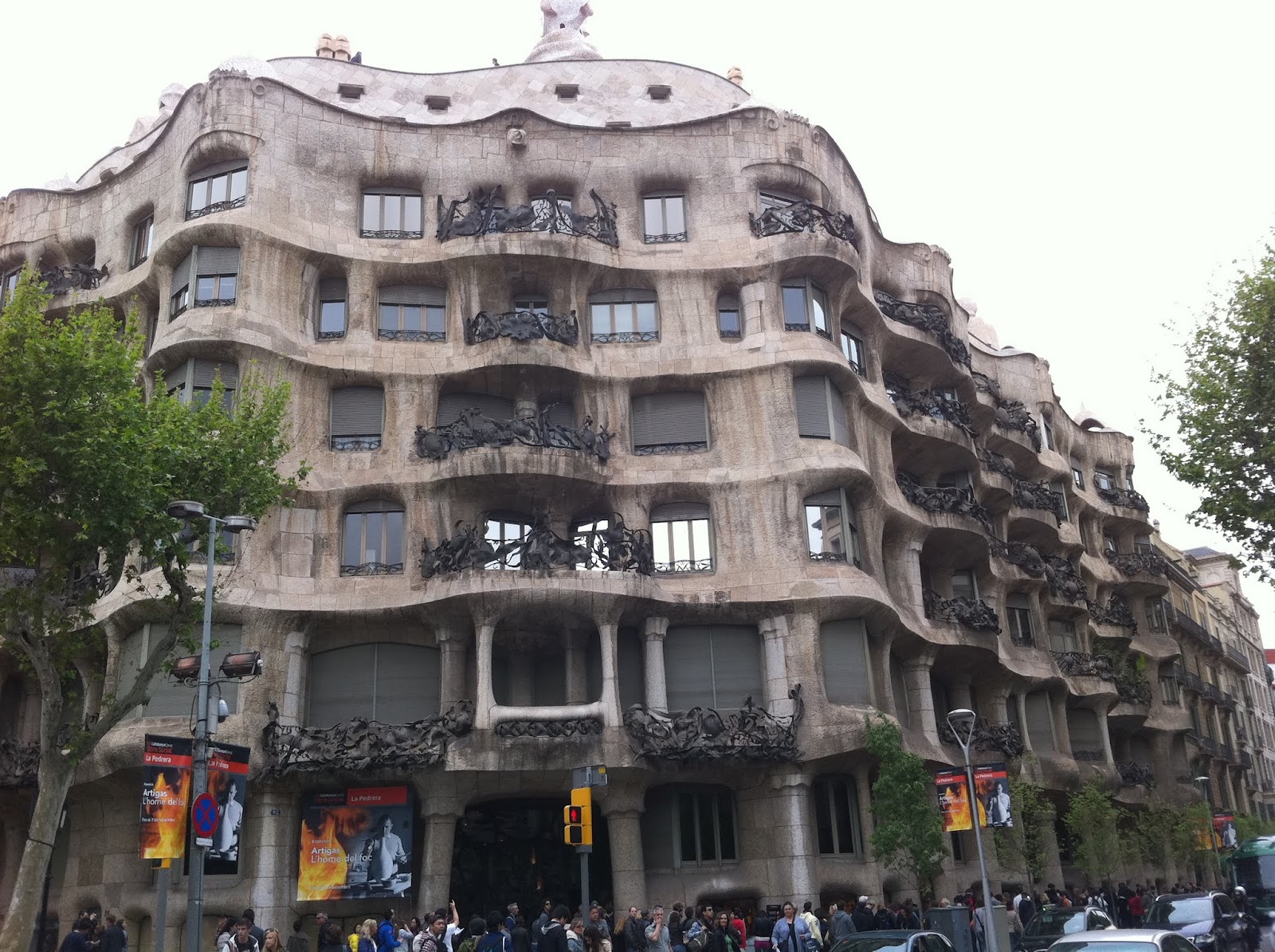
We take the Metro to the Passeig de Gracia station. From there we walk a few blocks to see Casa Batllo, one of Antoni Gaudi designed buildings. We don't visit the inside as there is a long line. We walk another few blocks to see Casa Mila/La Pedrera, another one of Gaudi's apartment buildings. This one is much bigger and has a rather remarkable rooftop. We do not enter due to long lines at this time. We will come back to La Pedrera later to see the roof. We search for a restaurant for lunch. We walk towards east, passing by many restaurants, but not picking any, in the hopes of finding a better one. By the time we find a restaurant, we realize that we are almost at Sagrada Familia. The restaurant is called Brasila, and has nice outside seating area. We get one large pizza and various tapas. From there we visit Sagrada Familia and are amazed by its size, even though it is not even finished. The Nativity facade is particularly amazing. I personally feel that this is the most impressive building I have ever seen. From there we walk to Hospital of the Holy Cross and Saint Paul through Gaudi Avenue. It is a nice walk with an impressive historic building at the end. 

Barcelona Cathedral
We take the Metro to Jaume I station and visit the Barcelona Cathedral. There is a long line at the entrance, but it is moving fast. It is very crowded inside, but quite amazing. Very impressive from the outside as well. We walk back to La Rambla and get a ticket to a Flamenco show. Never seen one before. The dance is amazing. We are not too impressed by the guitar. But the 'cante' is the part that ties them all together. Full of intense emotions. From there we walk back to the marina, and have dinner with sea view at TapaTapa in the Maremagnum mall. The food is decent, view is good. We go upstairs to Starbucks. It has a great view as well. It is already late and it starts raining. We take a taxi to the hotel.

La Pedrera
Day 3: We start the day by searching for breakfast. Yesterday's breakfast is still in our minds, and we fail to find a place that looks equally good. We walk up to La Pedrera still hungry. We end up picking up a boring (and unexpectedly expensive) sandwich. We then visit the rooftop at La Pedrera. Nice architectural elements and good view of the city, including a view of Sagrada Familia. From there we take the Metro to Valcarca station near Park Guell. The park is on a hill and again there are open space walking stairs that help you climb there. The park is nice both in terms of the nature and the Gaudi-designed buildings. It is extremely crowded though.

Sagrat Cor
We walk to the El Puxtet station and decide to take the Metro to the Tibidabo mountain. It turns out one needs to first take the metro to the Avenue Tibidabo station, then take the 'Blue Tram', and then take the Finicular to the top of the mountain (some ~550 meters). Before we start our journey, we first enter a patisserie next to the El Puxtet station. We eat an interesting desert that has ice cream inside (much to our surprise). Almost no English is spoken in this place. We then take the Metro to Avenue Tibidabo station. The weather is beautiful and the Blue Tram has a long line, so we decide to walk up to the Funicular. It is a long uphill walk, but the sights are great. Nice buildings in every corner. The Funicular takes us up to the mountain. We are surprised to see that there is an amusement park at the top of the mountain. There is even a roller coaster :) But we are more interested in Sagrat Cor church. It has a very commanding location at the top of the mountain and sees the entire city. We take an elevator to the top of the church, then take the side stairs to the top balcony, and another set of stairs to the very top. Simply breathtaking. For me, this was the best part of the trip.

Arc de Triomf
We take the Metro back to the top of La Rambla and from there walk to Arc de Triomf and visit the Ciutadella Park. The park is lively. We walk from the park to the beach. There is a walking way along the beach that has trees on both sides. It runs all the way to the marina. We take it. There is a small market place at the end that has a line of tents along the road, selling olive oil, sweets, sausages, etc. There is a street performer playing the didgeridoo. We pass through the Columbus monument and go up La Rambla back to Plaza Real to eat. This time we pick a nice restaurant called Kabul. We order a variety of tapas. Small fried fish tastes much like the Black Sea anchovy. We walk back to the hotel.

Fortress of Montjuic
Day 4: We decide to go to the same patisserie we went in Day 2 and avoid the painful breakfast place search. It is as good as the last time, if not better. From there we climb up to Montjuic again, but this time to visit the Joan Miro museum. The giant carpet is impressive. The paintings are 'interesting'. We are convinced that Miro has succeeded in  "assassinating painting" (in his own words). We take the teleferique to the fortress of Montjuic. It has an impressive view of the sea as well as the city.

We walk down the hill to El Raval. We walk through Rambla del Raval and see the big cat. We pass through Old Hospital de la Santa Creu. We then go to Barcelona Museum of Contemporary Art (MACBA). It has a nice building. The second floor is closed and the museum does not contain that many pieces in its collection. There are too many videos for my taste. Not impressed, especially compared to MoMA in New York.

Palau de la Musica Catalana
We wander around in Barri Gotic. We walk through Via Laietana. We go to Picasso museum only to find out that it is closed on Mondays. We find a restaurant named Bilbao-Berria for dinner. It has outside seating facing the Barcelona Cathedral! It has Basque style tapas. It is open buffet. The tapas look somewhat like sushis with the rice replaced with bread :) They are spiked with toothpicks and you pay at the end by the number of toothpicks you accumulate in your table. A lot of seafood varieties. Salmon, tuna, cod. Simply delicious. The best tapas we had so far. There is a street show taking place in the small square in front of the church. We visit Palau de la Musica Catalana and buy a ticket for a concert at night. We do some shopping until the concert. We listen to Carmen and Rodrigo's guitar concerto. We are able recognize only 3 pieces as familiar (not bad for us). The concert hall is amazing, a UNESCO world heritage site. We walk back to the hotel.

Day 5: It turns out that our last day in Barcelona is May 1st, which is Workers Day. Our plans in terms of visiting the Dali museum, which is an hour and a half away by Renfe train, go down the drain, as the museum is closed. We use the internet connection in the hotel to find a good breakfast place. It is named Federal Cafe and serves Australian style breakfast. It has a modern design. The food is good. We finally have some eggs for breakfast.

Labyrinth Park of Horta
We take the metro to the Mundet station to visit Labyrinth Park of Horta. It is a historical garden. Not a big tourist place so most people seem to be locals. Popular among families with kids. There is a long line though. The garden is very calm. Good for getting fresh air and clearing up your mind. The main attraction though, is the big labyrinth made out of cypress trees. We rest in the park for some time, and take the metro back to Jaume I station. We visit the Picasso museum again, and again find it closed, this time due to May 1st. We contend ourselves with the Picasso paintings we saw in MNAC two days ago. We visit the Santa Maria del Mar church. Cannot see the inside as it is closed. We find a pizza place called Bubo, which has outside seating with a nice view of the church.

Santa Maria del Mar
We then visit Neu Camp (no games this weekend), by taking the Metro to the Les Corts station. Again May 1st is at work. The stadium closes early that day. We visit the Barcelona store. Nice items, but extremely expensive (I am a Real Madrid fan, anyway). We view the stadium from the outside and travel back to La Rambla, Liceu station. We walk down to the beach area and rest. We walk back to Barri Gotic and pass through Santa Maria del Mar again. This time it is open! The inside is very impressive. Looks bigger inside than outside. The colons are nicely laid out. We find a place to have some deserts. Nice almond cake! We do some more shopping. We walk back to the top of La Rambla and decide to take a look at Sagrada Familia again to see it at night, hoping that it is illuminated. We take the Metro, and after a few stations find out that Sagrada Familia is dark, no lighting. We take the Metro back to Gran Via avenue and walk to the hotel, ending the day and ending the trip.